

Learning Experience Design
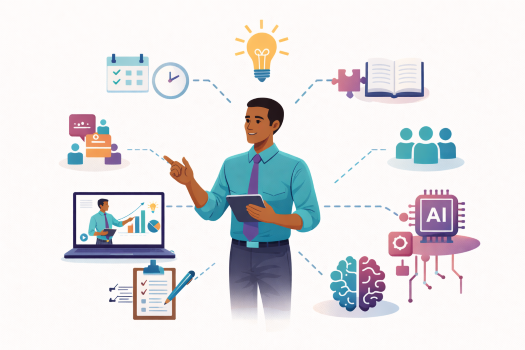
When learning is not working, the answer is rarely more training.
When training does not lead to real change, the instinct is often to add something.
- Another class.
- Another module.
- Another reminder.
Most of the time, that only adds noise.
Learning Experience Design helps organizations step back and understand what is really happening before deciding what to build or deliver.
Instead of starting with content, tools, or formats, this work focuses on:
- The decisions people need to make in their roles
- The situations where those decisions become difficult
- The gaps between knowing something and doing something
- The moments where learning tends to break down
From there, we design a learning approach that fits real work, real constraints, and real people.
WHAT STAKEHOLDERS EXPERIENCE
Shared understanding and a sense of direction
From the perspective of leaders, managers, and learners, Learning Experience Design brings relief.
Stakeholders experience:
- Clear alignment on what problem learning is meant to solve
- A shared language for talking about learning and performance
- Fewer reactive training requests
- Greater confidence in learning decisions
Instead of debating formats or tools, conversations shift to what people need to do differently and how learning can support that.
HOW THIS IS DESIGNED
A deliberate, visible design process
Learning Experience Design is not abstract. It produces tangible design work that guides everything that follows.
This design work often includes:
- A clear description of the learning challenge in plain language
- Defined learning goals tied to real performance
- A learning roadmap that shows how learning unfolds over time
- Decisions about which moments benefit from live interaction
- Identification of where self paced learning, practice, or reinforcement belong
These design artifacts make learning decisions visible. They allow stakeholders to see how the learning system fits together before anything is built.
This same design approach underpins our instructor-led training, blended learning, and custom eLearning solutions.
If learning feels scattered, ineffective, or harder than it should be, Learning Experience Design can help bring clarity.
We are happy to talk through your situation, ask a few thoughtful questions, and help you decide whether this work makes sense as a next step.
No pressure.
No obligation.
Just clarity.
PHASE 1: EMPATHIZE
Understand the people and the work
Before we design anything, we take time to understand the people involved and the reality of their work.
We ask questions, listen carefully, and observe how learning shows up in day to day situations. This is where trust is built and assumptions begin to fall away.
PHASE 2: DEFINE
Clarify the real learning challenge
Once we understand the people and context, we work together to clarify what is actually getting in the way. Very often, the presenting problem is not the real one. A request for training may be masking confusion, misalignment, overload, or lack of reinforcement.
In this phase, we define which problems are worth solving and which are noise.
PHASE 3: IDEATE
Explore learning approaches that truly fit
With a clear understanding of the challenge, we explore possible learning approaches. This is not about chasing trends or defaulting to familiar formats. The goal is usefulness.
PHASE 4: PROTOTYPE
Design the learning system
Rather than building full content immediately, we design a learning architecture or roadmap, sample learning flows, reinforcement strategies, and clear definitions of outcomes and success. This gives everyone something concrete to react to and refine before time and budget are committed.
PHASE 5: TEST
Pressure test before scaling
Before moving into full delivery, we take time to pressure test the design. Testing at this stage prevents costly rework and improves confidence moving forward.